Every year, like clockwork, Delhi chokes.
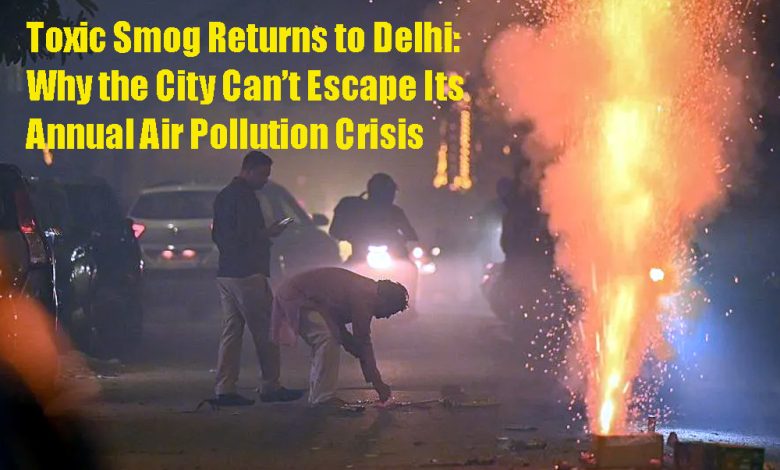
A thick, toxic haze blankets the city, stinging eyes, burning throats, and pushing air quality monitors into the “severe” zone. Over the past week, pollution levels in Delhi and its surrounding cities have fluctuated between the “poor” and “very poor” categories—peaking after Diwali, when fireworks lit up the sky and smothered the air with smoke. Headlines quickly declared it the worst post-Diwali air quality in four years.
Once again, India’s capital is grappling with its annual, predictable, yet preventable crisis—air pollution.
A Familiar and Deadly Pattern
Each year’s pollution spike stems from a combination of factors: firecrackers during Diwali, vehicle emissions, and the burning of crop residue in nearby agricultural states such as Punjab, Haryana, and Uttar Pradesh. As temperatures drop and winds slow, these pollutants become trapped close to the ground, forming the thick smog that chokes millions.
This year, the causes are under debate. Some reports suggest firecrackers are the primary culprit; others point to a rise in stubble burning.
According to Indian media citing a climate research firm, stubble-burning incidents dropped by 77% this year due to devastating floods that damaged crops in Punjab and Haryana. But official data from Punjab tells a different story. The Punjab Pollution Control Board reported that farm fire cases have tripled in the past 10 days, rising from 116 to over 350 incidents, according to PTI.
Why Farmers Keep Burning
Despite campaigns and subsidies promoting machinery to manage crop waste, stubble burning remains the cheapest and fastest way for farmers to clear their fields.
Government efforts have reduced the number of farm fires—from 36,663 in 2023 to 10,909 last year—but financial constraints keep many farmers reliant on burning. Equipment like “Happy Seeders” and balers remain too expensive, and subsidies are unevenly distributed.
Firecrackers and Legal Loopholes
The other major trigger this season: firecrackers.
Just days before Diwali, India’s Supreme Court relaxed a five-year ban on the sale and bursting of crackers in Delhi and the National Capital Region (NCR), allowing “green crackers” for six hours across two days.
Experts criticized the decision, noting that “green crackers” are only 20–30% less polluting, still emitting dangerous PM2.5 particles and toxic chemicals. On the ground, enforcement was almost nonexistent—fireworks began early in the morning, continued past midnight, and most were not “green” at all.
Health and Politics
Doctors across Delhi have reported spikes in respiratory distress, coughing, and eye irritation among residents. They warn that long-term exposure weakens immune defenses, increasing risks of asthma, heart disease, and lung cancer.
Yet, the human cost of pollution remains secondary to the political blame game.
Delhi’s Environment Minister Manjinder Singh Sirsa accused Punjab officials of “forcing farmers to burn stubble” to worsen the capital’s air. Punjab’s Aam Aadmi Party (AAP) government dismissed the charge, accusing Delhi of “lying about pollution” and “playing with people’s lives.”
A Crisis Without an Exit Plan
Despite years of debate and short-term measures—such as odd-even car rationing, temporary school closures, and bans on construction—the core issue persists: a lack of long-term coordination between state and federal authorities.
Experts insist that without sustained, joint efforts on clean energy, agricultural reform, and urban transport, Delhi will continue to suffocate each winter.
For now, as cold air settles and the wind dies down, Delhi once again disappears under a grey, choking sky—a tragic ritual that shows no sign of ending.