Kashmiris Stage Protest Outside UN Headquarters During Indian Minister’s Address

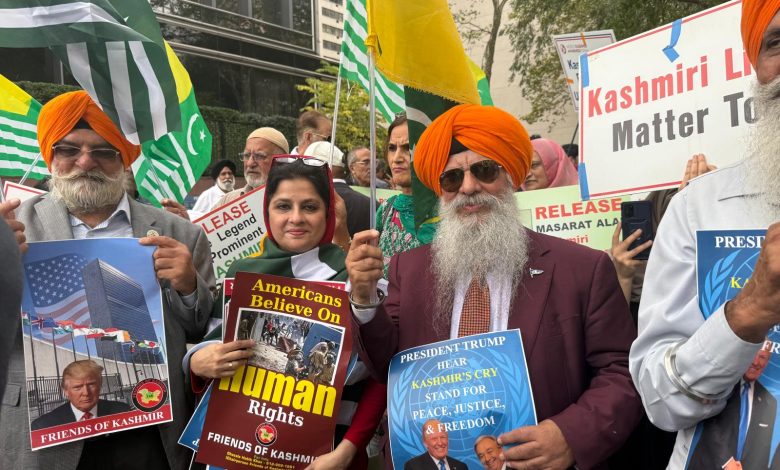
New York, September 28, 2025 – Hundreds of Kashmiri diaspora members and supporters gathered outside the United Nations headquarters to protest against alleged human rights violations and the ongoing military presence in Jammu and Kashmir. The demonstration, coordinated by Friends of Kashmir and other advocacy groups, coincided with Indian External Affairs Minister S. Jaishankar’s speech at the 80th session of the UN General Assembly (UNGA), drawing attention to the long-standing Kashmir dispute amid global discussions on peace and security.
 This event continues a pattern of Kashmiri-led protests during UNGA sessions, where activists seek to highlight their cause on an international platform. In 2019, following India’s decision to revoke Article 370, which granted special status to Jammu and Kashmir, large-scale rallies under initiatives like “Stand with Kashmir” led to heightened global awareness and occasional clashes with authorities. Similar demonstrations occurred in 2023 and 2024, often timed to Indian delegates’ addresses, emphasizing claims of extrajudicial actions and curbs on civil liberties. This year’s protest, amid UNGA’s focus on sustainable development and conflict resolution, serves as a reminder of unresolved UN Security Council resolutions from 1948 and 1949, which called for a plebiscite to determine the region’s future—a process that remains unimplemented due to differing interpretations by India and Pakistan.
At the forefront was Ghazala Habib, Chairperson of Friends of Kashmir International USA. A Kashmiri-American poet, author, journalist, and human rights advocate, Habib has authored books on Kashmir and hosts literary societies. She has been recognized for her global efforts, including a recent ceremony by the National Press Club in Pakistan. In her remarks, Habib stated, “Minister Jaishankar’s address cannot alter the realities on the ground in Kashmir, nor diminish the people’s resolve. Kashmiris will pursue their right to self-determination through peaceful means, in line with UN resolutions.”
Accompanying her was Dr. Amarjit Singh, a prominent Sikh leader and social activist from Jammu and Kashmir. Known for his work on minority rights and interfaith solidarity, Singh has spoken at events like Kashmir Solidarity Day and advocated against historical injustices, such as the 2000 Chittisinghpora massacre where 35 Sikhs were killed. He emphasizes the shared struggles of communities in the region. Also key was Dr. Ghulam Nabi Fai, Secretary General of the World Kashmir Awareness Forum and founder of the Kashmiri American Council. Born in 1949 near Srinagar, Fai, a U.S. citizen, has lobbied for decades for a UN-mediated resolution. His advocacy faced scrutiny in 2011 when he was convicted in the U.S. for failing to register as a foreign agent linked to Pakistan’s intelligence services; he served 16 months in prison. In 2025, an Indian court declared him a proclaimed offender in a related case. Fai maintains his work is focused on peaceful dialogue.
Other participants included Dr. Imtiaz, Raja Mukhtar, Muhammad Taj, and Farzana Khan, representing diverse voices from the Kashmiri community, including Muslims, Sikhs, and others. The crowd, estimated at over 500, carried signs reading “End Occupation in Kashmir” and chanted phrases like “Freedom for Kashmir” and criticisms of Indian leadership. Protesters shared accounts of detentions, disappearances, and restrictions under Indian administration, calling for an end to what they term “state repression” and the fulfillment of self-determination rights.
The rally remained peaceful, with New York Police Department maintaining security perimeters. Organizers stressed non-violence, aiming to urge the international community to address the Kashmir issue amid broader geopolitical tensions.
Indian officials rejected the protest as “propaganda orchestrated by external actors,” affirming that Jammu and Kashmir is an integral part of India. They highlighted post-2019 developments, including infrastructure projects, elections, and economic growth, which they say have brought stability. Jaishankar’s UNGA speech touched on regional security, indirectly referencing cross-border terrorism—a point often directed at Pakistan—without directly addressing the protest.
The demonstration’s occurrence during the UNGA could influence sidebar conversations among delegates, particularly from Pakistan, Turkey, and the Organization of Islamic Cooperation, which have raised Kashmir in past sessions. However, major powers like the U.S. and China typically view it as a bilateral matter between India and Pakistan. Advocacy groups hope it prompts renewed calls for dialogue, though experts note such protests have limited impact on formal UN agendas. As the assembly addresses global crises, the event underscores the persistence of regional disputes in multilateral forums.
(Reporting by International Desk; sources include UN records, diaspora statements, and official responses from India and advocacy groups.