India, Malaysia Deepen Strategic Ties with Focus on Trade, Defence and Semiconductors

India and Malaysia have reaffirmed their commitment to strengthening bilateral trade and expanding cooperation in key sectors including semiconductors, defence, food security, and healthcare.
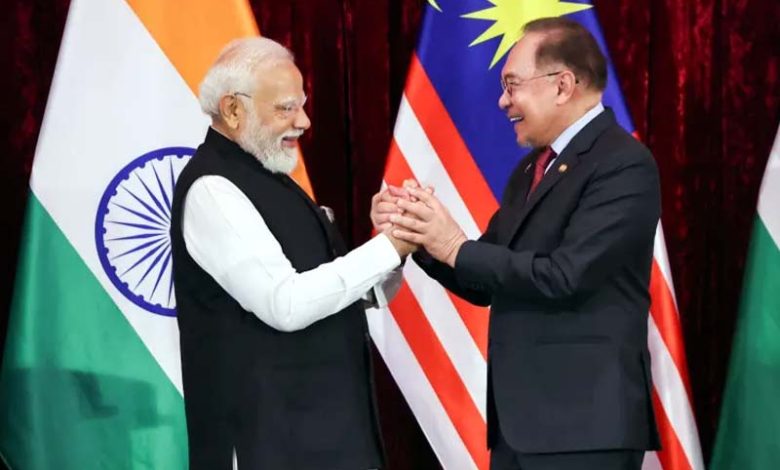
Indian Prime Minister Narendra Modi and Malaysian Prime Minister Anwar Ibrahim met on Sunday in Putrajaya, Malaysia’s administrative capital, where they pledged to enhance collaboration across trade and investment, defence, healthcare, tourism, and food security.
“It’s really comprehensive, and we believe that we can advance this and execute in a speedy manner with the commitment of both our governments,” Anwar said at a joint press conference after hosting Modi at his official residence, Seri Perdana.
Modi is on a two-day visit to Malaysia, his first since the two countries elevated their relationship to a comprehensive strategic partnership in August 2024. “Had an excellent meeting with PM Anwar Ibrahim at Seri Perdana earlier today. India and Malaysia are maritime neighbours who have always enjoyed a close friendship,” Modi wrote on X.
Following their talks, the two leaders witnessed the exchange of 11 agreements covering areas such as disaster management and peacekeeping. Anwar said both countries would continue promoting local-currency settlements for cross-border transactions and expressed hope that bilateral trade would exceed last year’s $18.6 billion.
Malaysia also pledged support for India’s plan to open a consulate in Sabah state on Borneo Island.
Defence cooperation, already a key pillar of the 2024 partnership, is expected to expand further. India and Malaysia have conducted five joint military exercises over the past five years, with both sides signaling greater collaboration ahead.
Semiconductors emerged as another major focus. “Along with AI and digital technologies, we will advance our partnership in semiconductors, health and food security,” Modi said.
Malaysia is the world’s sixth-largest semiconductor exporter, with the sector contributing about 25 percent to its GDP, according to official figures. India’s Ministry of External Affairs described Malaysia as having a “very strong semiconductor ecosystem” with 30 to 40 years of experience. The ministry said Indian companies are keen to collaborate in research and development as well as in setting up manufacturing and testing facilities.
Last June, Tata Electronics was reported to be in discussions with global semiconductor firms regarding the acquisition of a fabrication or semiconductor assembly and test plant in Malaysia.
In trade terms, India exported $7.32 billion worth of goods last year, primarily engineering and petroleum products, while imports from Malaysia totaled $12.54 billion, mainly minerals, vegetable oils, and electrical machinery and equipment, according to the India Brand Equity Foundation.