“Delhi’s Toxic Air Is Choking Its Children — And Parents Are Terrified”

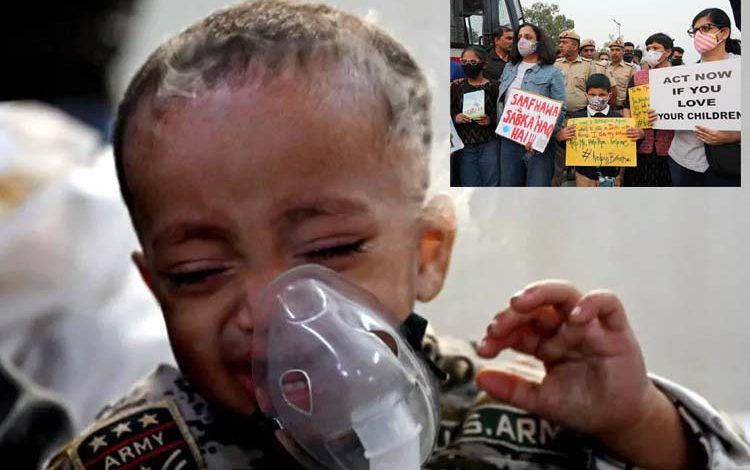
Hospitals across Delhi are witnessing a surge in children suffering from breathing difficulties as the capital remains smothered in toxic haze. While pollution spares no one, it is the city’s youngest residents who are paying the steepest price for Delhi’s worsening and recurring air-quality crisis.
At a paediatric clinic in Noida, visited by the BBC on a weekday morning, the impact was unmistakable. In a crowded waiting area, anxious parents queued with children who were coughing, sneezing, or struggling to breathe. Most had fallen sick in October, when Delhi’s air quality plunged to hazardous levels and waiting times for appointments grew longer than usual.
This toxic air emergency returns every winter across Delhi and large parts of northern India. The causes are multiple: low wind speeds, industrial emissions, vehicle exhaust, falling temperatures, and the seasonal burning of crop residue in neighbouring states.
Over the past month, Delhi’s Air Quality Index (AQI) has hovered between 300 and 400 — more than 20 times the World Health Organization’s recommended limit. Readings above 400 harm even healthy individuals and can severely affect those with existing conditions, but the fine particulate matter PM2.5 is especially dangerous for children and the elderly.
Hospitals across the capital have reported a wave of young patients falling sick due to the unbreathable air. “These particles affect a child’s immunity because their system is still developing and cells are learning immune responses,” said Dr Shishir Bhatnagar, the paediatrician at the Noida clinic. “These cases have increased tenfold in recent years. If I usually see 20–30% patients with such complaints, the number jumps to 50–70% during the pollution season.”
Every year, the government introduces emergency measures — halting construction, banning polluting vehicles — and this year even attempted cloud seeding to induce artificial rain. None of it has eased a pollution crisis that fuels deep anxiety among the city’s 20 million residents, especially parents of young children.
High exposure to PM2.5 remains most harmful for children.
Khushboo Bharti, 31, still trembles when recalling the night of 13 November, when she rushed her one-year-old daughter Samaira to the emergency room. “She woke up with a violent cough and vomited several times,” she said. Home remedies failed, and as they drove to the hospital, Samaira stopped responding altogether. “She wouldn’t lift her head. It was the worst moment of my life.”
Doctors treated the toddler with strong steroid nebulisation, and she spent two days on oxygen support before being diagnosed with pneumonia. Though Samaira has recovered, her mother remains on edge: “Even if she coughs just a few times, I panic.”
Other parents share the same fear. Gopal*, who recently took his two-year-old daughter Renu* to a government hospital for chest congestion, worries the lethal air may have caused lasting harm. “Doctors told me she might have to be on inhalers for some time,” he said.
Years of research have documented the severe toll of air pollution on young children — from stunted development and weaker immunity to reduced cognitive ability. A recent University of Cambridge study involving nearly 30 million people also linked prolonged exposure to certain pollutants with a higher risk of dementia, including Alzheimer’s disease.
These mounting risks have pushed many parents, like Ms Bharti, to consider leaving Delhi. “What’s the point of living in a city where my daughter can’t even breathe safely?” she said. “We can’t just drop everything because my husband’s business is here, but the moment we get a chance, we’ll move.”
In the meantime, authorities have postponed outdoor sports and shifted primary classes to hybrid mode to reduce children’s exposure. But these measures mostly benefit relatively privileged families. For hundreds of thousands of economically disadvantaged children living in cramped homes, roadside settlements, or shanty towns, the situation is far grimmer.
“The onslaught on their lungs is enormous,” said Dr A Fathahudeen, a Kerala-based pulmonologist. Indoor pollution from cooking fuels, traffic, and poor ventilation only adds to the toxic air outside. Continuous exposure weakens their lung defence systems, and untreated childhood infections can cause permanent lung damage. Studies show that early infections caused by polluted air can lead to chronic obstructive airway disease in adulthood — similar to patterns seen in smokers.
Dr Fathahudeen advises families who can afford it to keep children indoors, ensure proper hydration, and use N95 masks — which filter out 95% of pollutants — when outside. But parents say such precautions are difficult to sustain.
“They’re growing, they need space to play,” said Seema*, a mother. “They get brief moments outdoors, but we’re forced to stop them. They protest, but what choice do we have? We know how important physical activity is — just not at the cost of breathing this toxic air.