India and the South Caucasus: From Historic Ties to Strategic Engagement

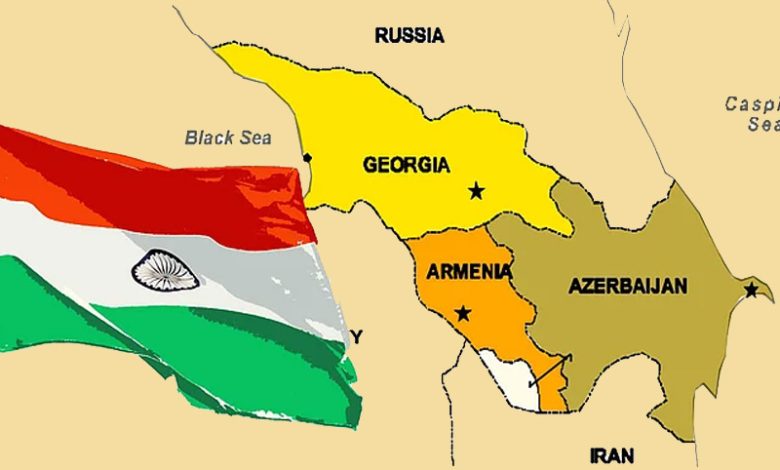
The South Caucasus—comprising Armenia, Azerbaijan, and Georgia—is a small yet geopolitically pivotal region, shaped by intense competition among regional and global powers. Situated at the crossroads of Russia and Europe, the Middle East, and Asia, the region’s strategic importance has grown following the 2020 Nagorno-Karabakh war and Azerbaijan’s full takeover of the territory in September 2023, which displaced around 120,000 ethnic Armenians and decisively shifted the balance of power in Baku’s favor.
India’s engagement with the South Caucasus blends ancient Silk Road linkages with the evolving geopolitical realities of the 21st century. Once peripheral to New Delhi’s foreign policy, the region has in recent years emerged as a core strategic focus, presenting both challenges and opportunities.
India’s relations with the three South Caucasus states are expanding across multiple domains, including strategic connectivity through the International North-South Transport Corridor (INSTC), defense cooperation—particularly with Armenia—alongside growing economic ties in energy, information technology, trade, education, and tourism. While Armenia has emerged as India’s closest partner, New Delhi continues to pursue pragmatic engagement with Azerbaijan and deepen cooperation with Georgia, carefully balancing great-power dynamics while supporting regional stability through connectivity and infrastructure development.
Historical and Cultural Foundations
India’s ties with the South Caucasus are rooted in centuries of trade, cultural exchange, and people-to-people contact. Historical records point to Indian settlements in Armenia as early as 149 BCE.
In Armenia, a long-established Armenian community in India reflects deep historical bonds. Mughal Emperor Akbar is known to have had an Armenian wife and granted Armenians commercial privileges. Historic Armenian churches still stand in Kolkata and Chennai, while the world’s first Armenian journal, Azdarar, was published in Madras in 1794.
In Azerbaijan, the Ateshgah Fire Temple in Baku bears inscriptions in Devanagari and Gurmukhi scripts, testifying to the presence of Indian Hindu and Sikh merchants who traveled along the Silk Road.
Georgia’s cultural ties with India were highlighted in 2021, when India returned the relics of Saint Queen Ketevan nearly four centuries after they were taken to Goa. This act of “relic diplomacy” significantly strengthened bilateral goodwill.
Political Engagement
Armenia has emerged as India’s key strategic partner in the region, driven by shared concerns over the Azerbaijan-Pakistan-Turkey nexus. The partnership has been substantially upgraded in recent years, marked by closer political alignment and expanded cooperation.
Relations with Azerbaijan remain pragmatic but constrained by Baku’s support for Pakistan’s position on Kashmir. Nonetheless, in line with its multi-alignment policy, India continues to engage Azerbaijan through energy cooperation, tourism, and trade.
Georgia is increasingly viewed by India as a gateway to the Black Sea. Bilateral ties have steadily improved since 2021, aided by Georgia’s neutral stance on India’s internal matters. Reflecting growing engagement, India opened a resident diplomatic mission in Tbilisi in July 2024.
Economic, Defense, and Connectivity Cooperation
The South Caucasus plays a crucial role in India’s efforts to establish reliable trade routes to Europe and Russia. Defense cooperation with Armenia stands out as a key pillar of India’s regional strategy, alongside expanding economic ties in pharmaceuticals, IT, tourism, education, and culture.
India-Azerbaijan relations rest primarily on energy trade and tourism, underpinned by civilizational connections and cultural affinities. In Georgia, Indian investments span steel, infrastructure, agriculture, and services, with major companies such as Tata Power, Geo Steel, Jindal Petroleum, and KEC International active in the country.
India is among the original proponents of the INSTC and is promoting a “Persian Gulf–Black Sea” corridor through Iran’s Chabahar Port, Armenia, and Georgia to Europe. While Azerbaijan remains a key node in the original INSTC route and an important energy supplier, India has diversified its options due to geopolitical considerations.
Defense: The Armenia Pivot
India’s defense partnership with Armenia has evolved into a full-fledged strategic alliance. Armenia is now India’s largest buyer of finished weapon systems, reflecting Yerevan’s need to diversify defense procurement and India’s “Make in India” export ambitions. Cooperation now includes joint training, military education, expert exchanges, and the deployment of military attachés in each other’s embassies.
India has supplied Armenia with Pinaka multi-barrel rocket launchers, Swathi weapon-locating radars, Akash surface-to-air missile systems, BrahMos supersonic cruise missiles, and anti-drone technologies. Since 2022, defense contracts signed by Armenia with India have exceeded $1.5 billion, accounting for an estimated 15–20% of India’s total defense exports and contributing significantly to New Delhi’s $5 billion export target.
This marks India’s transition from a major arms importer to an increasingly influential defense exporter, with the South Caucasus serving as an important showcase for its indigenous defense industry.
People-to-People Links
Education and tourism have become key drivers of engagement. Armenia and Georgia have emerged as major destinations for Indian medical students, with Indians forming one of the largest international student groups in Georgia. Azerbaijan, meanwhile, has seen a sharp rise in Indian tourists, becoming its third-largest source of visitors by 2024–2025, supported by direct flights from major Indian cities.
Indian professionals have also found growing opportunities in the region, particularly in Armenia’s expanding tech sector and Georgia’s agricultural industry.
Strategic Outlook
India-Armenia relations have accelerated through frequent high-level exchanges, expanding trade, and deepening defense ties. Both countries support each other on international platforms, with Armenia consistently backing India on Kashmir and expressing support during the India-Pakistan military crisis of 2025.
While the INSTC remains the overarching framework, India has increasingly focused on the Persian Gulf–Black Sea sub-route to bypass hostile neighbors and secure strategic access to Armenia. India has expressed support for Armenia’s proposed “Crossroads of Peace” initiative aimed at reopening regional borders, while maintaining its emphasis on the Iran-Armenia-Georgia axis.
Conclusion
India is steadily transforming from a regional observer into an active strategic player in the South Caucasus. Through a calibrated mix of defense cooperation, diplomacy, trade, energy engagement, education, tourism, and connectivity initiatives, New Delhi is advancing its interests while supporting a stable, multi-aligned regional order. Its approach reflects a pragmatic, country-specific strategy—anchored in a deep partnership with Armenia, balanced ties with Azerbaijan, and expanding engagement with Georgia—rather than a single, overarching regional framework.