“Choking on the Capital’s Air: Delhi Residents Protest as Toxic Smog Reaches Crisis Levels”

New Delhi: A suffocating haze has once again descended over India’s capital, turning the air acrid and nearly unbreathable as pollution levels soared to alarming heights. With the city’s Air Quality Index (AQI) hitting 344 on Monday—classified as “severe”—residents took to the streets, demanding urgent government action to confront what many are calling a full-blown public health emergency.
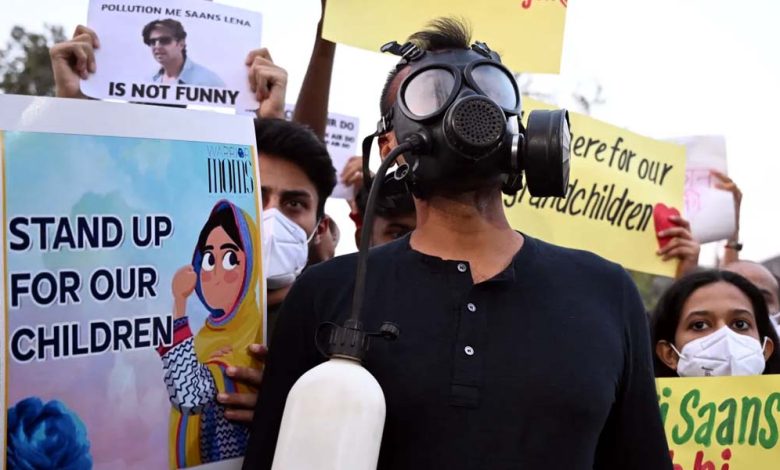
On Sunday, dozens of demonstrators gathered near India Gate, New Delhi’s iconic war memorial, braving the dense smog that obscured the skyline. Among them were children wearing protective masks and carrying hand-painted placards reading, “I miss breathing” and “I just want to breathe.”
“I am here today just as a mother,” said protester Namrata Yadav, who joined the rally with her young son. “I don’t want to become a climate refugee.”
Another participant, Tanvi Kusum, a lawyer, said she joined the demonstration out of frustration. “Year after year, it’s the same story, but nothing changes. We need to pressure the government to act decisively.”
The thick blanket of smog that grips New Delhi each winter is a recurring crisis. Cooler temperatures trap pollutants close to the ground, creating a deadly mix of vehicle emissions, industrial discharge, and smoke from crop-burning in neighboring states. The result is toxic air laced with PM2.5 particles—microscopic carcinogens that often exceed safe limits by more than sixtyfold.
At Sunday’s protest site, PM2.5 concentrations were over 13 times higher than the World Health Organization’s recommended daily exposure limit. Despite recurring promises, government responses have been largely symbolic, including sporadic vehicle restrictions and water trucks spraying mist to settle dust.
“Pollution is cutting our lives short,” said one young woman, identifying herself only as “a voice for Delhi.”
Scientific research underscores the urgency. A Lancet Planetary Health study estimated that 3.8 million deaths in India between 2009 and 2019 were linked to air pollution. Meanwhile, UNICEF has repeatedly warned that polluted air sharply increases children’s vulnerability to respiratory illnesses.
As evening fell, police intervened to disperse the growing crowd, detaining several activists and confiscating protest signs for lacking official permits. One torn placard left behind summed up the despair and determination of Delhi’s residents:
“I just want to breathe.”