
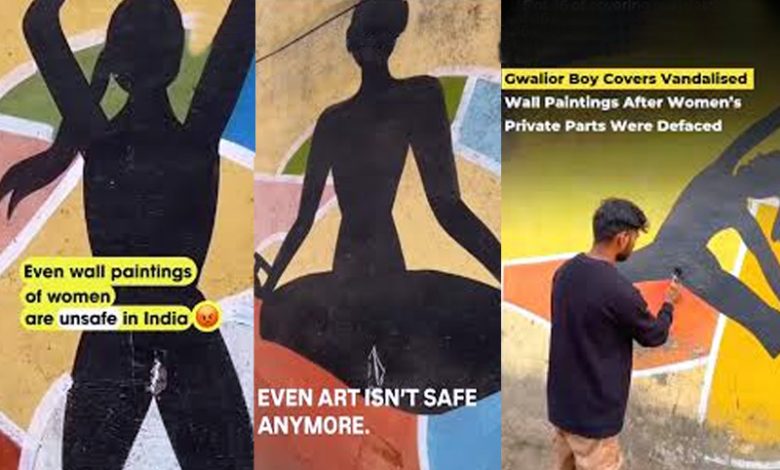
A viral video showing defaced artwork in the central Indian city of Gwalior has sparked widespread outrage, with activists calling the incident an attack on women’s dignity and questioning the official response of simply painting over the damage.
The video, shared last week on Instagram by a school student, showed female silhouettes painted on a public wall in yoga poses that had been scratched and marked around the genital area. In her post, the teenager said she passed the murals every day and felt “anger and disgust” at seeing the black silhouettes defaced with white markings.
“This is not harmless damage. This is cheap thinking, dirty mentality, and deep disrespect,” she wrote, adding that it was “shameful and extremely disappointing that even a woman’s painting isn’t safe from such sick minds.”
The footage quickly spread online, triggering condemnation from social media users and activists, many of whom said the images made them uneasy and showed that “women are not safe even in graffiti.” Indian media outlets described the vandalism as “shameful,” “embarrassing,” and “an attack on women’s dignity.”
City authorities responded this week by whitewashing the wall. However, critics argue that the move addresses only the surface problem, not the mindset that led to the sexualisation of even abstract female forms.
The murals were part of a city beautification project in Madhya Pradesh, reflecting India’s broader push to promote yoga through public art, including annual International Yoga Day celebrations. Similar yoga-themed graffiti can be found in cities across the country, including Delhi.
After the student’s video went viral, a local college student and social media influencer, Lokendra Singh, attempted to restore the artwork by painting over the obscene markings with black paint. “It requires courage to make something right in a public space,” he told the BBC. His own video later gained traction, prompting municipal authorities to step in.
Gwalior Municipal Corporation spokesman Umesh Gupta said the damage was caused by “some miscreants” who have not been identified, as there were no CCTV cameras in the area. He said whitewashing was underway and that new paintings would be commissioned once the process was complete.
It remains unclear whether the original yoga artwork will be restored. The civic body has announced a street wall painting competition to beautify the city, with themes such as cleanliness, environmental protection and responsible citizenship. Yoga, however, was not listed among them.
The decision to whitewash the murals has drawn criticism from those who say it misses the larger issue. The student who first posted the video told The Times of India that while walls can be repainted, “what about the mentality of the people who are objectifying even a black painting of a woman?”
Kalpana Viswanath, co-founder of Safetipin, an organisation working to make public spaces safer for women, said addressing such attitudes is far more difficult. She argued that even if the vandalism was dismissed as “harmless fun,” it amounted to sexual harassment.
“In a country where men dominate public spaces and women’s access to them is already fragile, incidents like this further restrict that access,” she said, noting that families often respond to such events by limiting women’s freedom.
Despite the anger, Viswanath sees a positive sign in the response. “It’s heartening to see young women refusing to stay silent,” she said. “Their voices, especially from smaller cities and towns, show remarkable courage in challenging patriarchy.”


