Bollywood Film Revives the Forgotten Heroism of India’s Rezang La Battle

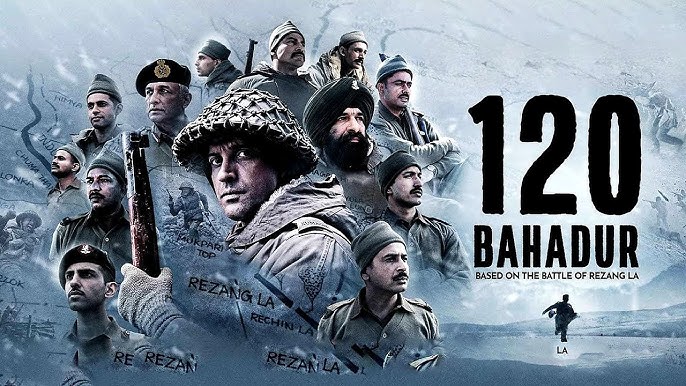
A recent Bollywood film has brought renewed attention to a largely overlooked chapter of the 1962 India-China war. Titled 120 Bahadur—Hindi for brave hearts—the film recounts the story of Indian soldiers who mounted a valiant defense of the Rezang La pass in the freezing Himalayan heights of Ladakh.
Starring Farhan Akhtar as Major Shaitan Singh, the film failed to make an impact at the box office but succeeded in reviving public memory of a battle often described as the sole silver lining in a war India ultimately lost.
“We felt it was very important that this story must be told. We wanted to honour the people who lived the story,” dialogue writer Sumit Arora told the BBC. “We have taken some cinematic liberties, but our film stays very true to history.”
The 1962 conflict erupted after relations between India and China deteriorated over unresolved border disputes. Beijing was also angered by India’s decision to grant refuge to the Dalai Lama following the 1959 Tibetan uprising. The month-long war began on 20 October, with China launching what it described as a “self-defence counter-attack,” accusing India of encroaching on Chinese territory and violating its airspace.
When China declared a unilateral ceasefire a month later—pulling back troops and releasing prisoners of war—India had lost around 7,000 soldiers and nearly 38,000 square kilometres of territory. The two countries were left separated by an ill-defined 3,440-kilometre Line of Actual Control, marked by rivers, lakes, and snowbound terrain.
China has said little officially about the war and has never commented on the battle of Rezang La. Fought at an altitude of more than 16,000 feet, it was just one engagement in a wider conflict China won. In India, however, Rezang La is remembered as an “epic battle” and one of the greatest last stands in military history, inspiring books and films.
The battle took place in the early hours of 18 November, from 3:30am to 8:15am. The pass overlooked the strategically vital Chushul airstrip, described by author Kulpreet Yadav as the region’s “primary nerve centre” at a time when road connectivity was minimal.
Only five of the 120 Indian soldiers survived. Major Shaitan Singh was among the dead and was posthumously awarded the Param Vir Chakra, India’s highest military honour. Twelve others received gallantry awards.
Initially, when survivors recounted their last stand, their accounts were met with disbelief. “The morale was low. We had lost the war bitterly, and thousands of our soldiers were taken prisoner,” Yadav says. “No one believed such a heroic last stand was possible.” It was widely assumed the troops at Rezang La had either fled or been captured.
Three months later, a shepherd stumbled upon destroyed bunkers, spent cartridges, and bodies frozen in snow. Only then did a clear picture of the battle emerge.
The soldiers belonged to C Company of the 13 Kumaon battalion, led by Major Singh. Though advised to retreat if ammunition ran out, Singh consulted his men, who replied, “We’ll fight till the last man, last bullet.”
What followed was a brutally uneven fight—120 Indian soldiers against an estimated 3,000 Chinese troops. The Chinese had superior weapons and equipment, while Indian soldiers were armed with semi-automatic rifles and limited ammunition. Many had never seen snow, lacked proper winter clothing, and had little time to acclimatise to the extreme conditions.
Despite repelling the first wave of attacks, Chinese mortar fire destroyed bunkers and tents, causing heavy casualties. A third assault wiped out most of the company. Survivors later described Major Singh continuing to give orders despite being gravely wounded, insisting others carry on the fight.
When officials and journalists reached Rezang La in February 1963, the battlefield was found exactly as it had been left—frozen in time. Soldiers lay dead at their posts, some still clutching weapons or medical supplies.
In a war “mostly remembered with shame,” Rezang La stands apart. C Company was later renamed Rezang La Company, and a memorial was built in Rewari, the soldiers’ hometown. The pass itself became a no-man’s land after the ceasefire.
Yadav argues that without the stand at Rezang La, India’s territorial losses could have been far greater. “If it was not for these soldiers, India might have lost half of Ladakh,” he says. “This battle was the only silver lining for India in the 1962 war.”