

Humayun Aziz Sandeela
As India navigates the second half of 2025, a retrospective glance at the second quarter—April to June—paints a chilling picture of a nation increasingly hostile to its religious and ethnic minorities. Under the continued dominance of the Bharatiya Janata Party (BJP), this period has been marked by escalating communal violence, state-sponsored discrimination, and the erosion of democratic safeguards. The evidence, drawn from reports and accounts of the time, reveals not just isolated incidents but a calculated campaign to marginalize entire communities.
A Climate of Fear and Fury
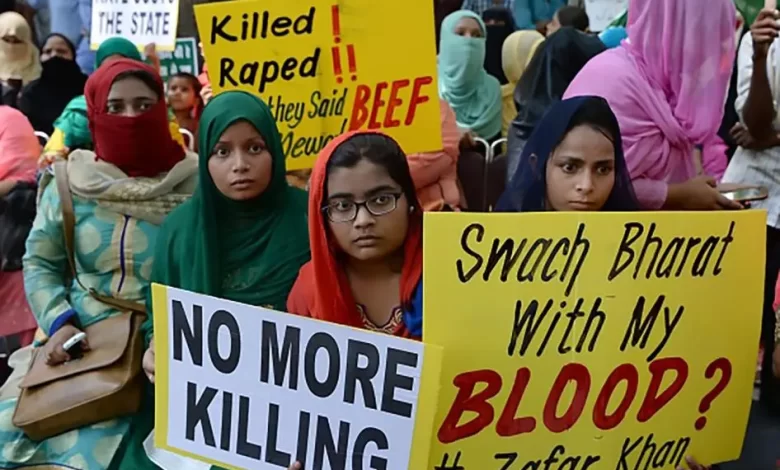
The statistics from April to June 2025 are staggering: seven extrajudicial killings of Muslims, over 50 Adivasis killed in anti-Maoist operations, and at least 11 Muslims lynched by vigilante groups. These numbers, while shocking, only hint at the pervasive dread that now defines life for India’s minorities. In Gujarat’s Chandola Lake area, over 10,500 Muslim homes were demolished without due process, in direct violation of Supreme Court guidelines issued in November 2024. In Uttar Pradesh, a Muslim woman was stripped of her hijab in public, and a 13-year-old boy was stabbed for refusing to chant Hindu religious slogans. These are not anomalies but symptoms of a broader societal shift where persecution is not just tolerated but orchestrated.
The normalization of violence has emboldened non-state actors, particularly cow vigilantes, who operate with near-total impunity. Their actions, often carried out under the guise of protecting cultural or religious values, are tacitly supported by political rhetoric. High-ranking BJP figures, including those who called for “revenge” following the April Pahalgam attack, have fueled this fire, creating an environment where mob rule thrives under political cover.
The State as Perpetrator
Far from acting as a protector, the Indian state has emerged as a primary agent of oppression. In Assam and Uttar Pradesh, mass detentions and deportations of Bengali-speaking Muslims and Rohingya refugees have proceeded without judicial oversight, flouting international principles like non-refoulement. In Chhattisgarh and Andhra Pradesh, anti-Maoist operations have served as a pretext for extrajudicial killings, disproportionately targeting Adivasi communities already marginalized by systemic neglect.
Legislative measures have further entrenched this exclusion. The amended Waqf Act has centralized control over Muslim endowments, stripping communities of autonomy. Voter verification campaigns in Bihar threaten to disenfranchise thousands of Muslims, echoing the Assam National Register of Citizens (NRC) exercise that left millions stateless. Anti-conversion laws, meanwhile, continue to criminalize interfaith relationships and religious expression, serving as tools of control rather than governance.
A Complicit Media and a Compromised Judiciary
India’s media, once a pillar of its democracy, has increasingly become a megaphone for disinformation. Pro-government outlets amplify inflammatory rhetoric, vilifying minorities and stoking communal tensions. Independent journalists, meanwhile, face harassment, censorship, or arrest, further silencing dissent. The judiciary, though occasionally issuing progressive rulings, struggles to enforce its decisions. The Supreme Court’s attempts to curb demolitions or challenge discriminatory laws are undermined by weak implementation.
The National Human Rights Commission’s downgrade to “B” status by the Global Alliance of National Human Rights Institutions (GANHRI) underscores a justice system increasingly seen as compromised. Victims of past violence, such as the 2020 Delhi pogrom, continue to wait for justice, while new waves of state and mob violence pile onto an already overburdened system.
A Nation at a Crossroads
India’s founding principles—secularism, equality, and freedom of belief—are under siege, not just by extremist groups but by the very institutions meant to uphold them. The term “undeclared Emergency,” referenced in reports from this quarter, is no exaggeration; it is a lived reality for millions of Muslims, Adivasis, and other marginalized groups. What is unfolding is not mere communal unrest but a deliberate architecture of repression, designed to render minorities voiceless, homeless, and without rights. The second quarter of 2025 serves as both a record of persecution and a warning of what lies ahead if this trajectory persists. The systematic dismantling of democratic norms threatens not only India’s minorities but the nation’s global standing as a democracy.
A Call for Global Action
Silence in the face of such documented atrocities is tantamount to complicity. Civil society, international human rights organizations, and democratic governments must move beyond issuing statements. Sustained scrutiny, conditional diplomacy, and support for grassroots resistance are critical. India, with its global economic ambitions and strategic partnerships, must be held accountable—not just for its actions on the world stage but for the injustices it permits within its borders.
The period of April to June 2025 is not just a chapter in India’s history; it is a forecast of a darker future if impunity goes unchecked. For India’s minorities, fear has become a constant companion. Whether justice prevails or democracy falters now hinges on how urgently the world chooses to respond.


