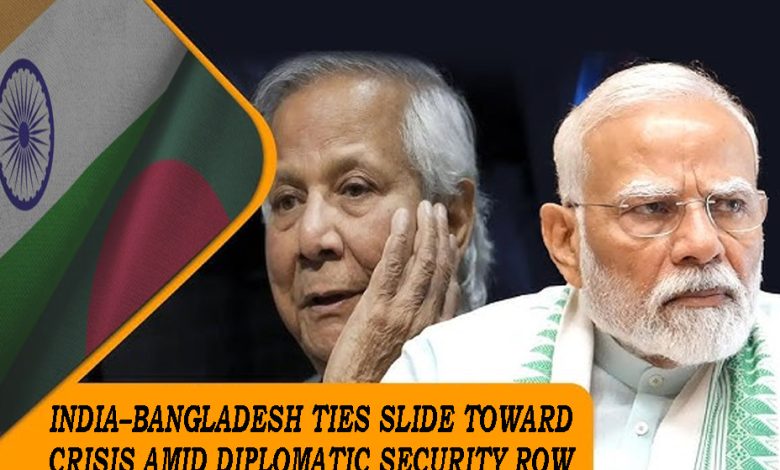
Relations between India and Bangladesh, already strained since the August 5 political changeover in Dhaka, have deteriorated further as both sides’ trade accusations over the security of their diplomatic missions.
On Sunday, the Indian Visa Application Centre (IVAC) in Chattogram suspended operations until further notice, citing the security situation at the Assistant High Commission of India (AHCI) in the port city. Earlier last week, IVACs in Dhaka, Khulna and Rajshahi were partially closed for a day each due to security concerns amid protests.
Tensions escalated after conflicting statements from Dhaka and New Delhi over a demonstration near the Bangladesh High Commission in the Indian capital. India’s external affairs ministry said a group of 20–25 youths protested on Saturday against the killing of garment worker Dipu Chandra Das in Mymensingh and called for the protection of minorities in Bangladesh, but insisted the protest did not pose a security threat.
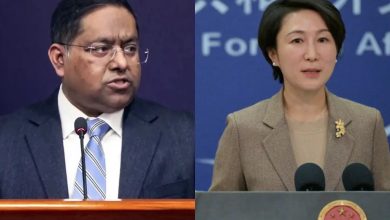
At a media briefing, Indian external affairs ministry spokesperson Randhir Jaiswal accused sections of the Bangladeshi media of spreading misleading propaganda. He said there was no attempt to breach security, adding that police dispersed the group within minutes.
In Dhaka, Foreign Adviser Touhid Hossain rejected India’s account, questioning how protesters were allowed to demonstrate within what he described as a highly secure diplomatic zone.
“Our mission is located deep inside the diplomatic area, not on the outskirts,” he said at a press briefing. “How could a group of 25 or 30 people from a Hindu extremist organisation reach so far unless they were permitted?”
Touhid said the demonstrators went beyond slogans over the killing and that information suggested death threats were made against Bangladesh High Commissioner Riaz Hamidullah, who lives there with his family. He said the family felt threatened due to inadequate security, with only two guards present.
“We believe it is the responsibility of that country to handle the situation more effectively,” he said, noting that protests are usually stopped far from such secure zones.
He added that while a Bangladeshi citizen had been murdered, there was no justification for equating the incident with minority security issues, stressing that Dhaka had taken immediate action. Bangladesh, he said, had noted India’s assurance regarding the safety of its missions, and both sides remained in contact. Asked about reducing diplomatic staff, Touhid said it would be considered only if the situation worsened.
The diplomatic row unfolds against a backdrop of worsening bilateral relations. After the August 5 changeover, when former Prime Minister Sheikh Hasina fled to New Delhi, India sharply restricted visa issuance and trade, while Bangladesh imposed limits on the import of Indian yarn through land ports.
While India has repeatedly voiced concern over alleged attacks on minorities in Bangladesh, Dhaka has dismissed the issue as an internal matter and accused sections of the Indian media of exaggeration and misinformation. Bangladesh has also urged India to prevent Hasina from making what it calls incendiary remarks that fuel instability.
Dhaka has formally requested Hasina’s extradition twice—once in December last year and again in November this year—after the International Crimes Tribunal sentenced her and former minister Asaduzzaman Khan to death. Indian External Affairs Minister S. Jaishankar recently said it was Hasina’s decision whether to return home, a remark analysts see as signalling reluctance to extradite her.
Tensions intensified further following the shooting and death of Inqilab Moncho leader Sharif Osman Hadi, with reports claiming the suspected shooter fled to India. On December 14, Bangladesh summoned Indian High Commissioner Pranay Verma over what it called “anti-Bangladesh activities” by fugitive Awami League members based in India, accusing them of planning and facilitating terrorist acts to disrupt upcoming elections.
India rejected the allegations, saying it has never allowed its territory to be used against Bangladesh. On December 17, New Delhi summoned the Bangladesh High Commissioner, citing a “deteriorating security environment” in Bangladesh and rejecting what it termed a “false narrative” by extremist elements.
Later that day, India reiterated its support for free and fair elections in Bangladesh, prompting Touhid to respond that no advice was needed from a country that, he said, remained silent on elections during the Awami League’s rule.
The same day, the IVAC at Jamuna Future Park in Dhaka shut early, citing security concerns, as protesters under the banner of July Oikya attempted to march toward the Indian High Commission demanding Hasina’s repatriation. Police intercepted the march at Rampura.