Pakistan and Bangladesh’s growing ties: A threat to India’s strategic interests?
M Haroon Abbas Qamar

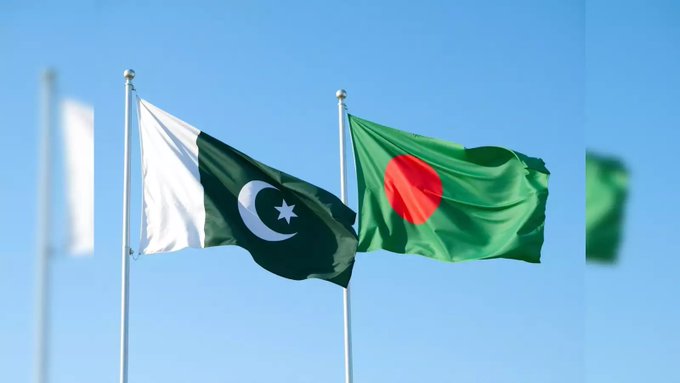
In recent months, significant political and strategic shifts have emerged in Bangladesh following the departure of Sheikh Hasina’s government. Bangladesh is increasingly moving closer to Pakistan, signaling potential changes in the balance of power in South Asia. This growing proximity between the two nations is laying the groundwork for new geopolitical alignments in the region.
A Shift Away from Indian Influence
Bangladesh appears intent on reducing its reliance on India, while simultaneously working to bridge political, military, and social gaps with Pakistan. This evolving partnership has raised concerns in New Delhi, as Pakistan and Bangladesh’s strengthened ties, coupled with China’s strategic ambitions in the region, could lead to heightened tensions for India.
Media reports reveal that high-ranking Bangladeshi military official General S.M. Qamar Hasan visited Pakistan on January 14, where he met with Pakistan’s Chief of Army Staff General Asim Munir. Speculation is rife that the two countries are negotiating a defense agreement, a development that could potentially upset India’s strategic calculations.
Strategic Visits Spark Concerns
 The interim Bangladeshi government, led by Mohammad Yunus, recently invited Pakistani military officials to Rangpur, a region near India’s strategically significant Siliguri Corridor—often referred to as the “Chicken Neck.” This corridor is vital for India’s geographical connectivity and security. The visit, coinciding with China’s increased interest in the area, has further fueled India’s anxieties.
Reports indicate that a delegation of senior Pakistani military and intelligence officials visited Rangpur on January 21, using Bangladeshi military helicopters for transportation. The delegation also toured the Chittagong Hill Tracts, another region of strategic importance.
Easing Bilateral Relations and Economic Ties
In a move to bolster bilateral ties, the Bangladeshi government has simplified its visa process for Pakistani citizens, aiming to strengthen trade and investment. The interim administration, under Mohammad Yunus, is actively pursuing improved relations with Pakistan—a notable departure from the strained ties of the past decade. In 2023-24, bilateral trade between Pakistan and Bangladesh reached $718 million, with both nations eyeing further economic collaboration.
Bangladesh, with its 180 million population, represents a lucrative market for Pakistan, particularly as Islamabad grapples with economic instability. Meanwhile, Dhaka views improved ties with Pakistan as a means to diversify its strategic partnerships and reduce its dependency on India.
Defense Cooperation and Regional Implications
Bangladesh’s growing defense collaboration with Pakistan has alarmed Indian policymakers. Reports suggest that Dhaka is considering the purchase of JF-17 fighter jets from Pakistan, a decision that could reshape the regional military balance. Previously, Bangladesh had expressed interest in acquiring similar aircraft from China, highlighting its ongoing efforts to modernize its military.
This rapprochement follows a historic development in December 2024, when Bangladesh requested the resolution of lingering disputes from the 1971 war, signaling its intent to move forward with Pakistan.
Rising Tensions with India
The warming ties between Bangladesh and Pakistan come as relations between Dhaka and New Delhi grow increasingly strained. The ousting of Sheikh Hasina’s government, following a student-led movement in August 2024, marked a turning point. Since then, India’s influence in Bangladesh has waned, and the interim government’s policies have fueled anti-India sentiments.
India’s strict stance on the illegal influx of Rohingya refugees has further aggravated tensions, with Dhaka accusing New Delhi of violating a 1975 border agreement. Bangladesh recently summoned the Indian ambassador to express its discontent over India’s border surveillance measures.
Domestic Challenges and Rising Extremism
Domestically, the interim government in Bangladesh has faced criticism for emboldening extremist factions and fostering anti-India activities. There has been a rise in attacks on minority communities and allegations of discrimination by the government. These developments, coupled with the country’s pivot toward Pakistan and China, could undermine India’s significant investments in Bangladesh.
Expert Analysis: A New Regional Challenge
Defense experts, such as General P.K. Sehgal, warn that Pakistan’s growing influence in Bangladesh poses a significant security challenge for India. Combined with China’s ambitions, the evolving dynamics could disrupt India’s strategic foothold in the northeastern region.
As Dhaka strengthens its ties with Islamabad and Beijing, India faces a diplomatic and strategic conundrum. Bangladesh’s interim Foreign Affairs Advisor, Touhid Hussain, recently visited China to discuss bilateral relations and trade, paving the way for Mohammad Yunus’s planned visit to Beijing in 2025.
The Road Ahead
Bangladesh’s pivot toward Pakistan and China signals a significant shift in South Asia’s geopolitical landscape. For India, these developments highlight the need for recalibrating its foreign policy to address emerging threats and safeguard its regional interests. Whether this realignment marks the beginning of a new power equation in South Asia remains to be seen, but it has undoubtedly added a new layer of complexity to the region’s strategic environment.