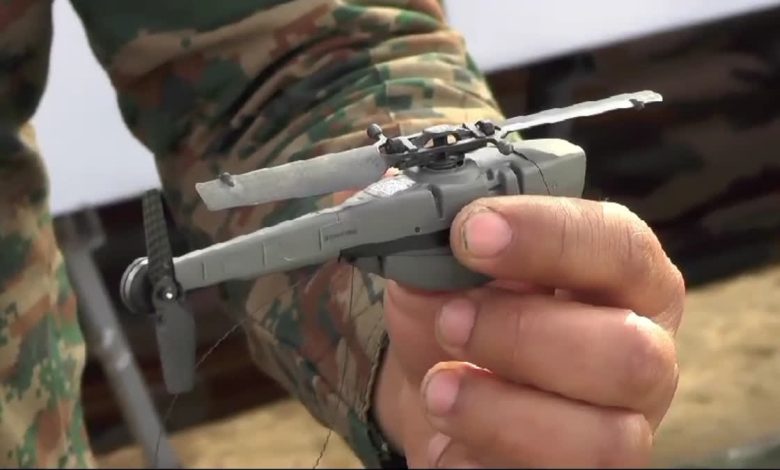
The Indian Army’s recent induction of the Black Hornet Nano drone has garnered attention for its potential to reshape battlefield dynamics, particularly in counter-insurgency and surveillance operations. Exhibited during the Ninth Veterans Day celebration at the Tanda Artillery Division in Jammu’s Akhnoor, this state-of-the-art technology underscores India’s commitment to integrating advanced equipment into its military arsenal.
The Black Hornet Nano: A Technological Marvel
At first glance, the Black Hornet Nano resembles a child’s toy, but beneath its unassuming exterior lies a powerful surveillance tool. Weighing a mere 18 grams and measuring only 16 centimeters in length, this drone is equipped with dual cameras, providing real-time situational awareness. Its compact size and silent operation make it nearly undetectable, granting Indian soldiers a significant tactical edge in identifying and neutralizing threats.
The drone’s capabilities are particularly suited for monitoring the challenging terrains of Jammu and Kashmir. Indian forces intend to deploy it to track insurgent movements, especially in border areas near Pakistan, where infiltration attempts remain a persistent challenge. The device’s ability to operate in near silence ensures it can observe without detection, providing crucial intelligence in high-stakes scenarios.
Historical Context: Evolving Drone Usage in South Asia
The deployment of the Black Hornet Nano is not India’s first foray into advanced drone technology. Over the years, drones have played an increasingly pivotal role in military strategy across South Asia:
India’s Heron Drones: Previously, the Indian Army and Air Force utilized Israeli-made Heron drones for reconnaissance along the Line of Control (LoC) and in anti-insurgency operations. These larger drones offered extensive coverage but lacked the discretion and mobility of the Black Hornet.
Pakistan’s Burraq UAV: In response to Indian advancements, Pakistan developed the Burraq, its indigenous armed drone, capable of precision strikes. The introduction of Black Hornet drones by India may push Pakistan to further innovate its counter-drone measures.
Global Influence: The global militarization of nano drones gained prominence when the U.S. employed similar technology for urban combat and counterterrorism missions in Afghanistan and Iraq. India’s adoption of the Black Hornet reflects its alignment with cutting-edge military practices.
Implications for Counter-Insurgency Operations
The induction of the Black Hornet Nano signifies a strategic shift in India’s counter-insurgency approach. Traditional reconnaissance methods often faced limitations due to visibility, noise, and operational range. The Black Hornet overcomes these hurdles, offering several advantages:
Enhanced Border Surveillance: Its use in border areas near Pakistan will help thwart infiltration attempts, potentially reducing militant incursions into Indian territory.
Urban Warfare: The drone’s ability to navigate tight spaces makes it ideal for identifying hidden insurgents during urban operations.
Soldier Safety: By providing real-time intelligence, the drone minimizes the need for soldiers to enter hostile zones blindly, reducing casualties.
However, the deployment of such advanced technology raises ethical and strategic questions. Will this escalate an already tense arms race in the region? How will insurgents and neighboring nations respond to the introduction of near-invisible surveillance?
Challenges and Future Prospects
While the Black Hornet Nano offers undeniable advantages, its operational success hinges on seamless integration into military strategy. Training soldiers to use this sophisticated equipment effectively will be critical. Additionally, ensuring the drone’s durability in the harsh climates of Jammu and Kashmir will test its design limits.
From a geopolitical perspective, the drone’s deployment may trigger further advancements in counter-drone technologies among adversaries. Countries like Pakistan and China are likely to scrutinize this development, potentially seeking to neutralize its impact through electronic warfare or similar innovations.