The Anatomy of a Manufactured Crisis: The Systematic Erosion of Life in Kashmir and Ladakh

To glance at the headlines emerging from Kashmir and Ladakh is to see more than a series of isolated controversies. From construction in sensitive high-altitude landscapes to concerns about religious freedom, food safety, examination integrity and political representation, each raises a fundamental question: who is accountable when people’s land, health, faith and future are put at risk?
In Indian-occupied Jammu and Kashmir, the language of development and integration is repeatedly invoked. But development without public consent, environmental safeguards and accountable institutions is not progress. It is power exercised over people rather than in their service. The constitutional changes of 2019, and the Supreme Court’s decision upholding them, did not erase profound questions about representation, autonomy and public trust. A court judgment is not a substitute for political confidence, nor does it relieve the government of its duty to listen.
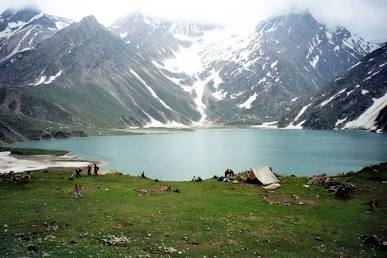
Consider Sheshnag. Reports and images of JCBs and construction activity in a sensitive high-altitude landscape demand clear answer: what work is being done, who approved it, and what environmental assessment preceded it? The region’s lakes, wetlands, glaciers and watersheds are not empty land awaiting machinery. They are living systems, vulnerable to erosion, waste, water stress and the cumulative pressures of tourism and construction. Any project that could damage them must face independent review, public disclosure and meaningful local consultation. Calling every objection “anti-development” is not an answer; it is a way of evading scrutiny.
The visuals and reports of heavy machinery operating near the pristine Sheshnag Lake, in the glacial zone of Pahalgam are very disturbing, raising serious concern among people about the ecological impact of construction in this fragile Himalayan region. With our glaciers already retreating, and recent devastating glacier-related floods in neighbouring Nepal reminding us of the growing vulnerability of the Himalayas, such activities raise alarm.
Kashmir has always warmly welcomed Amarnath Yatra pilgrims, and improving facilities for them has never been an issue. But not at the cost of our fragile ecosystem.
Those governing owe answers to people for the serious environmental concerns created by such “developmental projects”!
Our precious mountains, glaciers and water bodies need protection not plunder, for now and for the future generations. So this must be immediately stopped.
— Mirwaiz Umar Farooq (@MirwaizKashmir) November 23, 2026
The people who depend on these landscapes will bear the consequences of careless decisions long after contractors and officials have moved on. A government serious about climate resilience would publish impact assessments, monitor construction, enforce carrying-capacity limits and make restoration plans public. Without such safeguards, promises of economic benefit risk becoming a licence to degrade the very environment on which livelihoods and tourism depend. Development that destroys the resource it claims to develop is not progress. It is a bill passed on to the next generation.
Faith, too, must be protected from official overreach. If reports about “certificates of Touba”—certificates connected with repentance—refer to state officials or institutions attempting to certify private religious belief, the practice deserves immediate scrutiny. No government office should judge the sincerity of a person’s repentance or demand a performance of piety. If the phrase refers instead to a private religious or community initiative, that distinction should be established before accusations are made. But the principle is clear: faith belongs to believers, not bureaucrats. Religious freedom includes the right to practise, question or decline to participate without coercion.
The same demand for accountability applies to food safety. Reports of rotten or unsafe food in schools or public institutions, if substantiated, are not minor embarrassments. They point to failures of inspection and duty that can put children and other vulnerable people at risk. Authorities must disclose inspection results, identify suppliers, investigate complaints and impose consequences where standards have been breached. People need safe meals, not assurances issued after a scandal breaks. Hygiene is a basic obligation, not a favour.
An examination scandal can be just as damaging. For students, a compromised examination is not an abstract administrative failure: it can cost years of preparation, a job opportunity and faith in the idea that merit matters. Claims of paper leaks, irregularities or manipulated recruitment must be investigated independently, with findings made public and remedies offered to affected candidates. Young people’s anger should not be dismissed as political mischief. When institutions fail students, they corrode one of a region’s most valuable resources: confidence in the future.
Democracy cannot be reduced to polling day. Ladakh’s distinctive geography and severe winter conditions make election planning a matter of access and fairness. Yet the deeper question is whether people’s demands—for meaningful representation, protections for land and employment, and a say in decisions affecting their lives—are heard between elections. Holding a vote while leaving those concerns unanswered may satisfy a calendar without satisfying a community. Consultation must be real, not ceremonial; local priorities must shape policy, not merely appear in speeches.
The Human Rights Watch recent report tiled’ Analysis of Modi’s Authoritarian Playbook “2026 concludes that India is experiencing a systemic institutional crisis. By capturing the judiciary, the election commission, and the investigative agencies, the current regime has created a closed loop of power where there is no longer any effective check on executive action. This “authoritarian playbook” transforms the state from a protector of constitutional rights into an instrument of majoritarian control, leaving the most vulnerable populations without legal or institutional recourse.
Along with others its is the suffocating blanket of heavy military presence. The paradox is stark: the state claims the region is “normal,” yet it maintains one of the highest troop densities in the world. This militarization is the foundation upon which all other crises are built. It creates a climate of fear that allows ecological destruction to go unchecked, religious infringements to be ignored, and political engineering to flourish.
Conclusion
What is happening in occupied Kashmir and Ladakh is a coordinated effort to deepen a crisis of all kinds—environmental, spiritual, physical, and political. The government of India is not “integrating” these regions; it is hollowed them out. From the JCBs at Sheshnag to the rigged exam halls and the cold polling booths of Ladakh, the message is clear: the state values control over conservation, optics over authenticity, and obedience over existence.
The world must stop looking at these as isolated incidents. They are the symptoms of a singular, violent pathology. To remain silent is to be complicit in the slow-motion erasure of a people and their land.
Altaf Hussain Wani is the Chairman of the Kashmir Institute of International Relations (KIIR), specializing in the analysis of Kashmir politics, policy, and international advocacy. He can be reached on X at @sultan1913 or via email at [email protected].