Bangladesh ties of ‘great importance’ to Pakistan, President and PM tell visiting parliament speaker

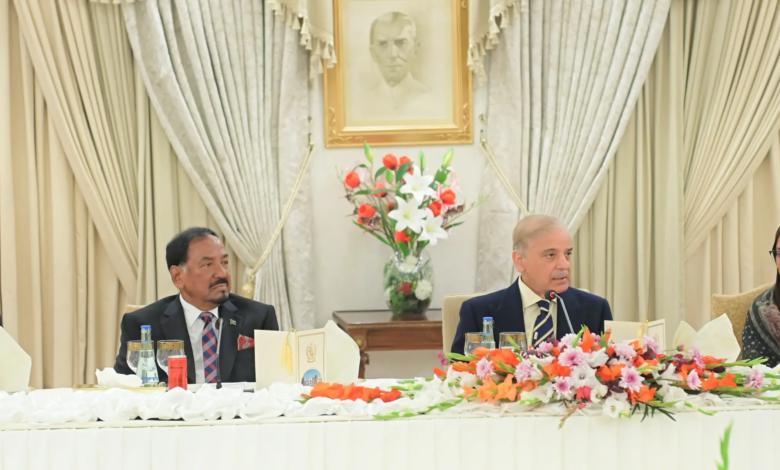
Bangladesh Parliament Speaker Hafizuddin Ahmad on Wednesday met with President Asif Ali Zardari and Prime Minister Shehbaz Sharif in Islamabad, where the Pakistani leaders reaffirmed that Islamabad attached “great importance” to its ties with Dhaka.
The parliament speaker, accompanied by a parliamentary delegation, arrived in the country on Monday on a six-day official visit at the special invitation of National Assembly Speaker Sardar Ayaz Sadiq. This is the first official visit to Pakistan by a speaker of the Bangladesh parliament, according to the PM Office (PMO).
On Wednesday, Ahmad and his delegation called on President Zardari at Aiwan-i-Sadr, where the president noted that “Pakistan attaches great importance to its relations with Bangladesh, which are rooted in shared history, common faith and deep cultural and familial affinities”, his office said.
The Bangladeshi delegation included MP Jahrat Adib Chowdhury, chairman of the standing committee on foreign affairs; MPs Humam Quader Chowdhury, Muhammad Nazibur Rahman, Nilufar Chowdhury Moni, and Nasser Rahman; as well as Bangladesh High Commissioner to Pakistan Iqbal Hussain Khan.
On Pakistan’s side, the meeting was attended by Sadiq, Senators Sherry Rehman and Saleem Mandviwalla, MNAs Naveed Qamar and Dr Shazia Sobia Aslam Soomro, along with the convener of the Pakistan-Bangladesh Parliamentary Friendship Group in NA.Later, PM Shehbaz hosted a dinner at the PM House in honour of the visiting speaker and members of the parliamentary delegation.“Welcoming the speaker and his delegation, the prime minister said that Pakistan attaches great importance to its fraternal ties with Bangladesh,” PMO said.Recalling the shared history and cultural affinities between the two countries, the premier underscored the importance of closer institutional cooperation and stronger people-to-people contacts.
1/2
President Zardari Calls for Forward-Looking Partnership with Bangladesh, Emphasises Parliamentary, Trade and Educational Cooperation
President Asif Ali Zardari has emphasised the need to strengthen Pakistan-Bangladesh relations through expanded parliamentary exchanges, trade and economic cooperation, educational links and people-to-people contacts, calling for a forward-looking approach based on sovereign equality, mutual respect and mutual benefit.
The President expressed confidence that the visit of Speaker of the Bangladesh Parliament, Hafiz Uddin Ahmad Bir Bikram, would help advance bilateral relations and pave the way for more high-level exchanges between the two countries.
President Zardari said Pakistan attaches great importance to its relations with Bangladesh, which are rooted in shared history, common faith and deep cultural and familial affinities.
The President noted the renewed momentum in bilateral relations, particularly in high-level exchanges, education, trade, culture and people-to-people contacts. He highlighted the considerable potential for cooperation in agriculture, industry, food security, disaster management, digital governance, space research and defence. He also expressed hope for the early finalisation of around 26 MoUs under consideration, which would provide an institutional framework for expanding bilateral cooperation.
President Zardari congratulated Bangladesh on the election of Barrister Adib Chowdhury, Chairman of the Parliamentary Foreign Affairs Committee, to the Executive Committee of the Inter-Parliamentary Union (IPU). He expressed Pakistan’s desire to further strengthen parliamentary cooperation, including at international parliamentary fora, and welcomed efforts to establish a Pakistan-Bangladesh Parliamentary Friendship Group.
The President offered Pakistan’s assistance in facilitating training for Bangladeshi parliamentary officials at the Pakistan Institute for Parliamentary Services (PIPS) and sharing its institutional expertise in operating a bicameral legislature.
President Zardari highlighted Pakistan’s educational initiatives, including the Pakistan-Bangladesh Knowledge Corridor launched last year, which offers 500 fully funded scholarships to Bangladeshi students at leading Pakistani universities. He noted that 170 Bangladeshi students have already joined Pakistani universities, while another 20 are expected to join shortly.
He also welcomed the positive response to the Executive Leadership Training Programme for senior Bangladeshi civil servants at the National School of Public Policy, Lahore.
The President welcomed growing cooperation in the media domain and the ongoing visit of a delegation of diplomatic correspondents from leading Bangladeshi newspapers to Pakistan. He observed that frequent media exchanges could promote greater mutual understanding among the peoples and opinion-makers of both countries.
On connectivity, President Zardari welcomed the commencement of direct flights by Biman Bangladesh Airlines and emphasised the need to increase flight frequency and destinations in view of growing demand. He also called for exploring direct maritime links to facilitate trade and economic cooperation.
Discussing trade and economic relations, the President noted that bilateral trade remains below its potential. He called for effectively utilising existing mechanisms, including the Joint Economic Commission and the Joint Working Group on Trade, to explore preferential trade arrangements and advance the priority areas identified during the Joint Economic Commission session held in October last year.
—-
— The President of Pakistan (@PresOfPakistan) November 25, 2026
The prime minister noted that the “extensive engagements of the visiting parliamentary delegation in Pakistan indicate a huge scope of collaboration in parliamentary domain”, PMO said.
‘Pakistan ready to extend defence cooperation with Bangladesh’
During his meeting with the visiting delegation, President Zardari emphasised the need to strengthen Pakistan-Bangladesh relations through expanded parliamentary exchanges, trade and economic cooperation, educational links and people-to-people contacts, calling for a “forward-looking approach based on sovereign equality, mutual respect and mutual benefit”.
He noted the “renewed momentum in bilateral relations, particularly in high-level exchanges, education, trade, culture and people-to-people contacts”, the Presidency said.
The president expressed hope for the early finalisation of around 26 memorandums of understanding (MoUs) “under consideration, which would provide an institutional framework for expanding bilateral cooperation”.
He “reaffirmed Pakistan’s readiness to extend defence cooperation with Bangladesh”, also highlighting the “considerable potential” for cooperation in agriculture, industry, food security, disaster management, digital governance and space research.
On connectivity, President Zardari welcomed the commencement in January of direct flights by Biman Bangladesh Airlines and emphasised the need to increase flight frequency and destinations in view of growing demand. He also called for exploring direct maritime links to facilitate trade and economic cooperation.
Discussing trade and economic relations, the president noted that bilateral trade remained below its potential.
Therefore, he called for effectively utilising existing mechanisms, including the Joint Economic Commission (JEC) and the Joint Working Group on Trade, to explore preferential trade arrangements and advance the priority areas identified during the JEC session held in October last year.
President Zardari noted that ongoing exports of Pakistani rice under the government-to-government agreement could serve as a basis for broader cooperation on food security and the supply of essential commodities.
“Pakistan, in line with Bangladesh’s request, is also ready to provide technical expertise for the refurbishment of sugar plants in Bangladesh,” the Presidency statement read.
President Zardari encouraged greater private-sector engagement across a range of sectors, including textiles, pharmaceuticals, leather, automobiles, construction materials, minerals, chemicals, ceramics and jute.
He offered Pakistan’s assistance in facilitating training for Bangladeshi parliamentary officials at the Pakistan Institute for Parliamentary Services (PIPS) and sharing its institutional expertise in operating a bicameral legislature.
The president expressed Islamabad’s desire to further strengthen parliamentary cooperation with Dhaka, as well as highlighted bilateral cooperation in the education and media sectors.
President Zardari welcomed progress under the China-Bangladesh-Pakistan Trilateral Mechanism, particularly the identification of 12 priority areas of cooperation during the Kunming meeting on June 19, 2025, the statement said.
He appreciated Bangladesh’s humanitarian gesture of hosting over one million Rohingya refugees, reaffirmed Pakistan’s support for their safe, voluntary and dignified return to Myanmar in accordance with international law, and called upon the international community to ensure sustained humanitarian assistance.
The president expressed confidence that Ahmad’s visit would help advance bilateral relations and pave the way for more high-level exchanges between the two countries.
Meanwhile, Ahmad thanked the president for the warm welcome and hospitality extended to him and his delegation, according to the President House.
The speaker conveyed the greetings of Bangladesh President Mirza Fakhrul Islam Alamgir and Prime Minister Tarique Rahman.
The statement said: “Recalling his personal memories of Pakistan, he underscored the importance of parliamentary diplomacy and expressed his desire to promote closer engagement between the two Parliaments through exchanges and regular institutional interaction.
“He also noted the popularity of Pakistani television dramas in Bangladesh, reflecting the cultural affinity between the peoples of the two countries.”
Relations between Islamabad and Dhaka have improved since the ouster of former Bangladeshi premier Sheikh Hasina, during whose tenure ties between the two countries remained shaky.
In February, Planning Minister Ahsan Iqbal attended the oath-taking ceremony of PM Rahman of the Bangladesh Nationalist Party (BNP).
Sadiq travelled to Dhaka in December 2025 for the funeral of the country’s first female prime minister Khaleda Zia. In August that year, Deputy Prime Minister and Foreign Minister Ishaq Dar had also visited Dhaka and met Yunus.